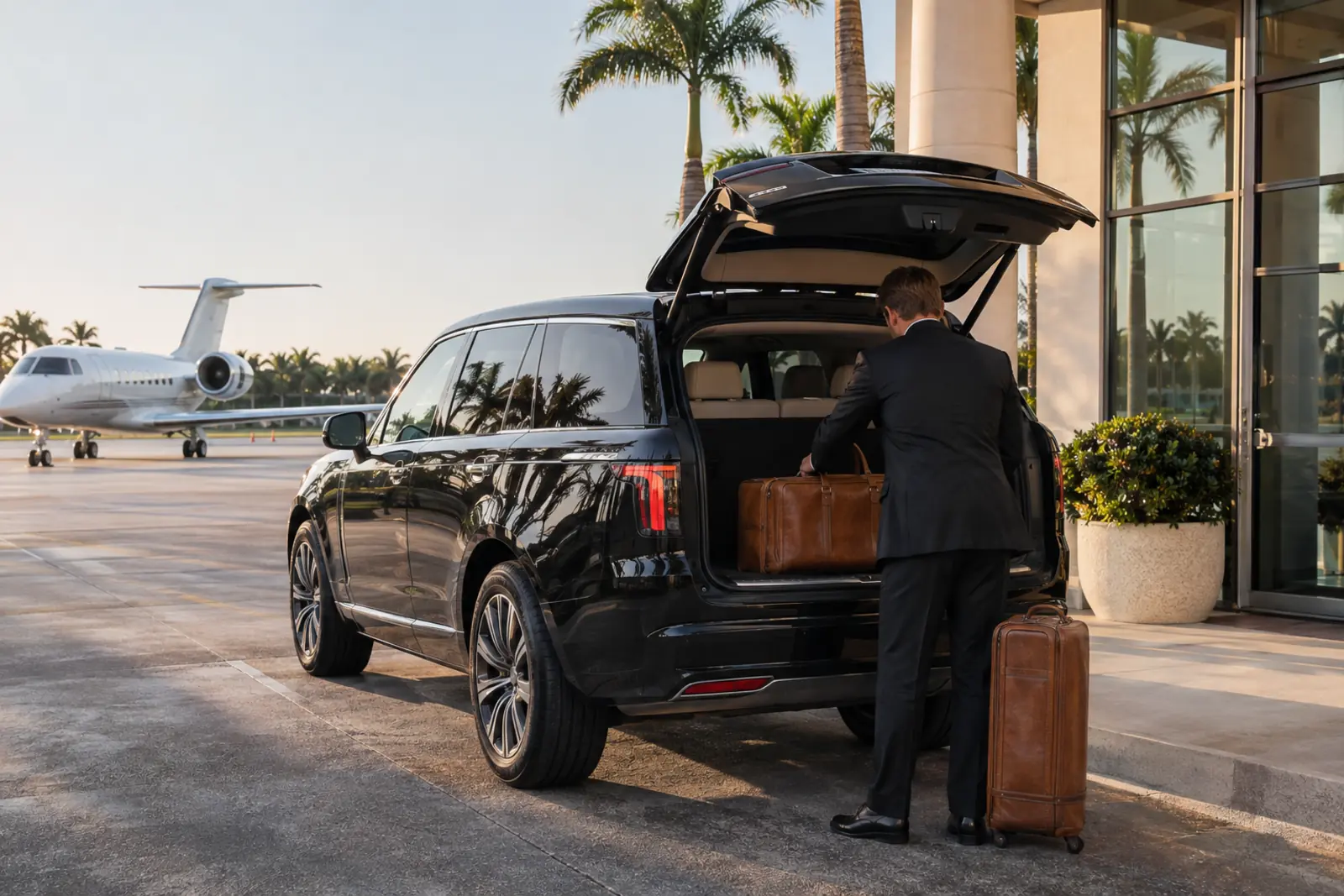
Private aircraft arrivals in Palm Beach follow a path that has nothing in common with the commercial terminal experience. No luggage carousel, no arrival hall, no ride-share staging zone. When a Gulfstream, Citation, or Phenom lands at Palm Beach International, the aircraft taxis to the ramp of a fixed-base operator - an FBO - and the entire ground-side experience flows from that private facility, not from the main terminal building a quarter-mile away.
For anyone arranging ground transportation for a private aviation arrival, understanding the FBO environment is not optional. It shapes vehicle selection, the booking process, driver access, and billing. It is also the difference between a passenger who steps off their aircraft and finds a car waiting inside the lounge versus one who stands outside an unfamiliar facility trying to call a driver who pulled up to the wrong entrance. This guide covers how FBO ground transport works in Palm Beach County, which facilities serve the region, what experienced providers do differently, and the specific questions worth asking before confirming any booking.
What FBO Ground Service Means and Why It Differs from Curbside Pickup
A fixed-base operator is an aviation services company that holds a lease at an airport and provides fuel, ground handling, maintenance, hangar storage, and passenger amenities to general aviation aircraft. The term dates from the early days of civil aviation, when regulators required that aircraft operators establish a fixed - meaning permanent rather than itinerant - base of operations. Today, FBOs range from modest fuel stops at small regional airports to purpose-built facilities with private suites, conference rooms, and amenities that rival members clubs.
What matters for ground transport is that the FBO is a private terminal. It has its own entrance, its own secured parking and ramp area, and its own access perimeter that is entirely separate from the commercial side of the airport. When a business jet arrives, it taxis to the FBO's designated ramp and shuts down there. Passengers deplane, walk a short distance across the apron, and enter the FBO lounge - which typically offers comfortable seating, refreshments, Wi-Fi, and a quiet alternative to anything resembling a public airport. No TSA exit corridor, no baggage claim hall, no general public in the same space.
The separation from the commercial terminal creates a fundamentally different pickup scenario. A comparison makes the distinction concrete:
Commercial Terminal Pickup
- Passengers exit through a fixed public arrivals door or baggage claim area, following the same path as every other traveler on that flight
- Ride services and limousines queue in a designated curbside zone managed by the airport authority
- Flight arrival is tracked by a published flight number with an official scheduled time
- Passengers move through TSA exit lanes, baggage claim, and public corridors before reaching the curb - a process that takes 20 to 45 minutes even under good conditions
FBO Pickup
- Passengers deplane on the ramp and enter through the FBO's airside door into a private lounge
- Vehicle access to the FBO parking and staging area is controlled - drivers must be known to FBO staff, pre-registered, or cleared in advance
- No published flight number or departure time exists - private aircraft operate on demand and schedules shift frequently
- The transition from aircraft door to vehicle can take as few as five minutes if the car service is correctly staged and the driver is already inside the lounge
The access control element is particularly significant. FBOs are not public facilities. A driver who arrives without prior coordination may be held at the security gate, directed to a general parking area with no lounge access, or in some cases turned away from areas where vehicles stage close to the ramp. Car services that work FBO pickups regularly maintain relationships with the facilities in their territory, know the access registration process at each one, and can position the driver inside the FBO lounge before the aircraft lands.
Timing is the other critical difference. Commercial arrivals come with a published flight number that any driver can monitor on FlightAware or Flightradar24. Private aviation has no equivalent. A passenger might say they expect to land around 4 p.m. and touch down at 3:40 or 5:15 depending on winds, ATC routing, or a late departure. The correct tool for tracking a private flight is the aircraft's tail number - the N-number, which is the unique identifier registered to that specific aircraft. A car service that asks for the N-number at booking can monitor the inbound flight from wheels-up at the departure airport to touchdown at PBI or whichever field is in use, and position the vehicle accordingly.
Main FBOs Serving Palm Beach International and the Surrounding Region
Palm Beach International Airport (PBI, ICAO: KPBI) in West Palm Beach is the primary commercial and general aviation airport for Palm Beach County. It handles a substantial general aviation operation on the west side of the field, entirely separate from the commercial terminal, and it is where the majority of private jets traveling to the Palm Beach area arrive.
Signature Aviation at PBI
Signature Aviation - the world's largest FBO network, with locations at several hundred airports across the United States and internationally - operates an FBO at PBI. For Palm Beach-area private aviation, Signature handles a significant share of business jet traffic at the field. Drivers working with Signature facilities generally encounter a consistent access protocol: check-in at the front desk, presentation of identification, and assignment to a designated staging area or lounge access depending on the relationship the car service has established with that specific location.
FBO configurations at any airport can change over time as operators expand, merge, or change ownership. The authoritative current source for which FBOs operate at a specific field is AirNav.com, the NBAA FBO directory, or a direct inquiry to the aircraft crew or charter broker, who will know exactly which facility their aircraft is using for a given flight. That information - the specific FBO name, not just the airport code - is what needs to be passed to the car service at booking.
Nearby Private Aviation Airports
PBI handles the broadest range of private aviation traffic in Palm Beach County, but it is not the only field in the region where business jets arrive. Ground transport providers serving both Palm Beach and Broward County - as covered in the broader airport chauffeur service guide for PBI, FLL, and regional FBOs - work across several airports depending on where a given aircraft is based or where a charter operator handles their ground logistics.
Boca Raton Airport (BCT, KBCT) sits in the southern part of Palm Beach County and is used by lighter general aviation aircraft as well as some charter operations. Its smaller footprint and minimal commercial traffic make it a convenient choice for passengers arriving from the Boca Raton and Delray Beach corridor. Sun Aviation has been an established presence at BCT, though as with all FBO information, verifying the current operator before a booking is good practice.
Fort Lauderdale Executive Airport (FXE, KFXE) is Broward County's primary general aviation field and handles significant private jet traffic from passengers who prefer to avoid the congestion of Fort Lauderdale-Hollywood International. FXE has multiple FBO operators, and car services covering both counties work this field regularly. For anyone staying in northern Broward County - Parkland, Coral Springs, Weston - FXE is often closer and faster than PBI or FLL for the final ground leg.
Opa-locka Executive Airport (OPF, KOPF) primarily serves the Miami-Dade area but occasionally factors into transfers for clients in the southernmost part of Broward County, particularly for aircraft based at that field.
International Arrivals and Customs at FBOs
One feature of PBI that matters significantly for car service logistics is its Customs and Border Protection (CBP) facility for private aviation arrivals. Flights arriving from the Bahamas, Caribbean, Bermuda, or other international destinations can land at PBI and complete immigration and customs processing within the FBO environment - without routing through the commercial international terminal. This CBP service capability is a genuine advantage for Palm Beach-area residents who travel regularly between South Florida and island destinations by private aircraft.
For the car service, an international FBO arrival means accounting for the additional time that customs processing adds to the sequence. Depending on the number of passengers, the documentation involved, and CBP staffing at the time of arrival, this processing can add anywhere from 15 to 45 minutes after touchdown before the passenger exits the facility. The driver should know in advance whether the inbound flight is international, so the staging time is set appropriately from the start rather than creating a situation where the driver has been waiting in the lounge for 40 minutes without understanding why.
Vehicle Classes Typically Used for FBO Arrivals
Vehicle selection for an FBO pickup depends on passenger count, luggage volume, and the nature of the trip. Private aviation passengers often carry more than commercial travelers - there is no checked bag limit on a private jet, and golf bags, ski equipment, oversized duffels, and specialty cargo are common. The vehicle needs to actually hold the load, not just seat the passengers.
Executive Sedan
A full-size executive sedan - the Mercedes-Benz S-Class, BMW 7 Series, Audi A8, or equivalent - works well for a solo traveler or a couple with compact luggage. The sedan is the right call for a business traveler arriving for a day of meetings with carry-on only, or a couple coming in for a Palm Beach weekend with moderate baggage. Its constraint is trunk space: a large-cabin jet arriving with four pieces of oversized luggage and a golf bag will exceed what any sedan handles gracefully.
Full-Size SUV
The Cadillac Escalade, Chevrolet Suburban, and Lincoln Navigator are the most requested vehicle class for FBO pickups in Palm Beach County. The combination of generous cargo capacity, four large doors, privacy glass, and an elevated presence makes the full-size SUV the default for most FBO transfers. Three passengers with golf bags, four passengers from a family trip with large checked-equivalent bags each, or a single VIP who wants space without a limousine - the Escalade or Suburban handles all of these without compromise. Many experienced private aviation travelers request these vehicles specifically. The executive chauffeur service guide covers what to look for in this vehicle category and how providers in the Palm Beach market differ.
Executive Sprinter Van
When a business jet arrives with its full complement of passengers - six, eight, or more - or when a production, sports, or entertainment party has substantial equipment, an executive Sprinter is the right vehicle. A properly configured Sprinter carries eight or more passengers in aircraft-style seating with significant cargo space behind the rear row. For group FBO arrivals from productions filming in Palm Beach, sports teams using private charter, or a full executive team traveling together, the Sprinter handles logistics that would require multiple sedans and still leave luggage without a vehicle.
Stretch Limousine
Stretch limousines appear at FBO pickups for celebratory occasions - wedding parties, milestone birthday arrivals, special event arrivals. For the typical business or leisure private aviation arrival, the stretch is less functional than an SUV due to limited cargo capacity and the impracticality of loading large luggage pieces into a vehicle not designed for it. Many FBO ramp and staging areas also have tight turning radii that make longer vehicles awkward to position.
Matching Vehicle to Actual Luggage
The practical advice here is to give an honest luggage description when booking, not an optimistic one. A car service that asks about luggage before confirming a vehicle class is doing its job. A service that confirms a sedan for an arrival that includes two golf bags and four large pieces has not asked the right questions - and the passenger will find out at the ramp when the bags do not fit. Private aviation passengers should communicate luggage accurately and expect the car service to recommend based on that information.
How Booking Works: Meet-and-Greet Logistics at a Private Terminal
The booking process for an FBO transfer involves several steps that simply do not exist for a standard commercial pickup. Getting each step right is what separates a smooth, invisible arrival from one where the passenger hunts for their driver while standing outside an unfamiliar facility in the South Florida heat.
Information Needed at Booking
The essential piece of information for any FBO pickup is the aircraft tail number. For US-registered aircraft, this is the N-number - a string beginning with "N" followed by numbers and sometimes letters (for example, N412BJ). This identifier allows the driver to track the specific inbound flight on FlightAware, ADS-B Exchange, or similar tools, monitoring its actual progress from departure to arrival at PBI or whichever field is in use. Without the tail number, the driver is working only from an estimated time that may bear little resemblance to when the aircraft actually lands.
Beyond the tail number, the booking should include: the name of the specific FBO at the destination airport (not just "PBI" - which FBO within PBI), an expected arrival window, the number of passengers, an honest luggage description, and whether the arrival involves international customs processing. For regular travelers, some car services maintain a client profile that stores aircraft tail numbers and default vehicle preferences, which speeds up future bookings considerably.
Flight Tracking and Driver Staging
A car service that takes FBO work seriously does not simply set a reminder for the stated arrival time. The driver monitors the inbound flight from departure. Most private flights into Palm Beach originate from the Northeast, Midwest, Texas, or the Caribbean - flight times ranging from 90 minutes to roughly four hours for most common origin cities. The driver tracks the aircraft through its entire flight, noting wheels-up, en-route progress, and the estimated arrival at PBI.
The driver stages at the FBO well ahead of estimated touchdown - not at the estimated arrival time, but meaningfully before it. That staging time is part of why FBO transfers carry a minimum billing period. The driver checks in at the FBO front desk, confirms access, and positions both themselves and the vehicle. If the flight arrives early, the driver is already there. If it runs late, the driver adjusts by continuing to monitor the inbound and communicating with whoever is managing the booking on the client side.
Meet-and-Greet Inside the Lounge
The standard for quality FBO ground transport is a meet-and-greet inside the FBO lounge, not at the curb outside. The driver enters the facility, checks in with FBO staff, and waits in the lounge seating area. When the arriving aircraft lands and the passenger walks in from the ramp, the driver is already in the room - either with a name board or by prior arrangement that allows the passenger to identify them without it. This inside-the-lounge standard is what it means to execute an FBO pickup correctly.
A driver who parks outside and waits at the hood of the car has not understood the product. The passenger exiting an FBO is not expecting to walk through a parking lot looking for a vehicle. The experience should be: step off the aircraft, walk into the lounge, see the driver, move to the vehicle. Total transition time, correctly executed, should be five to ten minutes from aircraft door to seated in the car.
Not every car service has the FBO relationships or the operational protocol to execute this. Asking directly - "Will your driver meet me inside the lounge at this specific FBO?" - is a reasonable and important question before confirming a booking. If the answer involves waiting outside or at the curb, that signals the service does not specialize in private aviation ground transport.
Schedule Changes and Communication
Private aviation schedules change with meaningful frequency. Maintenance holds, ATC delays, weather diversions to an alternate airport, last-minute passenger changes, extended ground time at the departure end - all of these happen and shift the arrival window. A reliable car service has a point of contact reachable by phone or text who can receive updates and adjust driver staging without requiring the passenger to manage the ground logistics from the aircraft. This communication layer is part of what distinguishes a service built for private aviation from one that handles FBO pickups as an occasional variation on their normal commercial airport work.
Cost Factors: Why FBO Transfers Are Priced Differently
FBO transfers in Palm Beach County typically cost more than a standard commercial airport run of comparable distance. The reasons are structural, not arbitrary, and understanding them helps evaluate whether a quoted price reflects the actual service or is simply inflated.
Minimum Billing Time
Because private aviation schedules are variable, most car services billing for FBO transfers apply a minimum number of billable hours rather than a simple point-to-point rate. A driver who stages at an FBO for a flight that might arrive anywhere within a two-hour window cannot be priced the same as a driver dispatched to a commercial gate with a 15-minute margin. Minimums of two to three hours are standard in the market. This is not excessive given the actual driver time involved - it reflects the reality of what private aviation ground transport requires operationally.
Wait Time Policy
If a flight runs significantly later than the initial estimated arrival - beyond 30 to 45 minutes in most policies - wait time charges apply beyond the minimum. The key is understanding exactly when complimentary waiting time ends and when additional billing begins. Quality services distinguish between normal private aviation schedule variance, which they absorb within the minimum time, and genuine extended delays that warrant additional billing. For international arrivals requiring CBP processing, that added time should be reflected in the initial quote or handled through a clearly stated policy - not as a surprise line item on the final invoice.
FBO Access Fees
Some FBO facilities charge ground transport operators a fee to access the ramp area, the lounge, or designated vehicle staging zones. This fee - which varies by FBO and can change over time - may appear as a separate line item in a transfer quote or may be absorbed into the base rate depending on how the car service structures its pricing. Asking whether an FBO access or facility fee applies to the specific location is a reasonable transparency check when evaluating competing quotes.
Vehicle Class and After-Hours Surcharges
An Escalade or Suburban commands a higher base rate than a sedan, and that differential applies to FBO pickups as it does to any transfer. A meaningful percentage of private aviation arrivals into Palm Beach happen in the evening - flights from the Northeast or Midwest arriving after the business day, international arrivals from time zones that make late evenings natural arrival windows during the Palm Beach season from November through April. After-hours surcharges, standard across the luxury ground transport industry, are a routine component of FBO transfer pricing and should be disclosed upfront.
Account and Retainer Arrangements
For regular private aviation travelers or those managing travel for executives who use Palm Beach as a primary or seasonal base, a car service account eliminates the friction of per-trip quoting, payment processing, and re-explaining preferences for each booking. The chauffeur account and retainer guide covers how these arrangements work, what they typically include, and how they are structured for seasonal and year-round travelers in this market.
What to Expect from Arrival to the Car
Understanding the step-by-step sequence at an FBO helps both passengers and their travel coordinators communicate accurate information - and set realistic time expectations for whatever schedule follows the arrival.
When the inbound aircraft is roughly 20 to 30 minutes from landing, the pilot or crew contacts the destination FBO's operations desk to announce arrival, confirm the ramp or hangar assignment, and arrange any services needed. At this point, an attentive car service is already monitoring the inbound flight and moving the driver into final staging position at the FBO.
The aircraft lands, taxis to the FBO ramp, and shuts down. Depending on the aircraft type, passengers deplane via integral airstairs built into the aircraft door, portable stairs positioned by FBO ground staff, or in a small number of cases a jet bridge - though FBO-side jet bridges are uncommon and most general aviation deplaning happens directly onto the ramp. FBO ground staff may meet the aircraft to assist with luggage and direct passengers to the lounge.
Passengers walk from the aircraft across the apron - typically a short distance - and enter the FBO through a secure airside door that leads to the lounge. At this moment, for a correctly staged transfer, the driver is already in the lounge. The greeting happens inside. The transition from aircraft door to lounge to vehicle takes five to ten minutes under normal conditions.
If international customs processing is required, it occurs within the FBO or in a designated CBP area before the passenger exits the facility. For small groups arriving on a typical Caribbean or Bahamas flight, this process generally takes 15 to 30 minutes. The car service should know in advance and have the driver staged to wait comfortably in the lounge rather than pressing the passenger.
Luggage is typically handled by FBO ground staff or the aircraft crew, carried from the aircraft into the lounge or staged at the vehicle. The driver loads the vehicle, and departure happens from the FBO's private exit - directly to the access road, without navigating the commercial terminal loop or its traffic. The total time from wheels-down to leaving the FBO property, for a domestic arrival at a well-run facility with a staged car service, is typically 10 to 20 minutes. This is one of the genuine efficiencies of private aviation, and ensuring the ground transport side is as well-organized as the air side is what protects it.
Questions to Ask Before Booking an FBO Transfer
These questions help distinguish a car service with genuine private aviation expertise from one that handles FBO pickups as an occasional exception to their standard commercial airport work.
Do you track tail numbers, or rely on the estimated arrival time the passenger provides?
The answer should be tail number tracking. Any service that does not ask for the aircraft's N-number during the booking process is not monitoring the actual flight. An estimated arrival time is a starting point, not a schedule. Drivers who work from the stated time alone will frequently be either too early or too late when schedules shift - and private aviation schedules shift regularly.
Have you worked at this specific FBO before, and do you have an established relationship there?
FBO access relationships matter operationally. A car service that works regularly at Signature Aviation at PBI will have drivers recognized at the check-in desk, familiarity with the specific staging protocol, and a track record with the facility's staff. A service doing its first run at that location will navigate all of that in real time on arrival day, which creates friction when the goal is a seamless experience.
What is your wait-time policy for delayed private flights?
Understand exactly when complimentary waiting time ends and when additional charges begin. Quality services distinguish between normal schedule variance - which they absorb within the minimum time - and genuine extended delays. For international arrivals, ask specifically whether customs processing time is covered or billed separately.
Can your driver meet me inside the FBO lounge?
This is the standard for quality FBO ground transport. If the answer is "we wait at the curb outside," that signals the service does not operate at the standard private aviation travelers expect. Meeting inside the lounge requires FBO access, prior coordination, and an established relationship with the facility that not every car service has built.
Are there any FBO facility or access fees, and are they included in the quote?
A complete quote accounts for all fees. If the service adds them after confirmation, ask why they were absent from the original price. This is a minor but telling indicator of how transparently the service communicates about its cost structure.
What happens if the aircraft diverts to a different airport?
Diversions from PBI to FXE, BCT, or even FLL due to weather, airspace restrictions, or operational factors are uncommon but do happen. A car service prepared for this scenario has a plan and can redirect the driver without starting a new booking process from scratch. For international diversions or customs-related routing changes, the complexity increases, and a service with experience handles it without requiring the passenger to manage the logistics.
Do you offer account billing for recurring FBO transfers?
For travelers who arrive by private aircraft on a regular basis - whether seasonally in Palm Beach or year-round - an account arrangement is more efficient than the per-trip cycle of quoting, approving, and paying. Asking about this option even before the first transfer helps establish what a longer-term relationship with a preferred provider might look like.
Frequently Asked Questions
What information does a car service need to arrange an FBO pickup in Palm Beach?
The most important piece of information is the aircraft's tail number (N-number for US-registered aircraft), which allows the driver to track the actual inbound flight rather than relying on an estimated arrival time. The booking should also include the specific FBO name, the expected arrival window, passenger count, and an honest luggage description. If the arrival involves international customs processing at the FBO, note that in advance because it adds 15 to 45 minutes between touchdown and the passenger exiting the facility.
Can a chauffeur come inside the FBO terminal, or do they wait outside?
A car service with established FBO relationships and the right operational protocol can typically send the driver inside the lounge to meet arriving passengers after checking in at the front desk. This inside-the-lounge standard means passengers are greeted immediately upon walking in from the ramp, without needing to search a parking area for their vehicle. Ask this question directly before confirming any FBO booking, since not every car service operates at this level.
Why does FBO car service cost more than a standard airport transfer?
FBO transfers require the driver to stage at the facility for a variable window of time before the aircraft arrives, creating a minimum billing period of two to three hours rather than a flat trip rate. Some FBOs charge ground transport operators an access fee, full-size SUVs carry a higher base rate than sedans, and a significant share of private arrivals happen in the evening with standard after-hours surcharges. The premium also reflects the specialized knowledge and FBO relationships required to execute the pickup at the standard private aviation travelers expect.
Which airports in Palm Beach and Broward County have FBO facilities for private jets?
Palm Beach International (PBI) in West Palm Beach is the primary general aviation airport for Palm Beach County, with Signature Aviation among its established FBOs handling a large share of business jet traffic. Boca Raton Airport (BCT) serves the southern part of the county with lighter traffic, and Fort Lauderdale Executive Airport (FXE) is the main private aviation field for Broward County. FBO configurations and operators change over time - verify current operators through AirNav.com or directly with the aircraft crew or charter broker before booking.
What is the difference between a meet-and-greet at an FBO and at a commercial terminal?
At a commercial terminal the driver waits in a public arrivals hall as passengers exit the secure zone through a fixed public door. At an FBO the driver enters the lounge itself - the private space where passengers arrive directly from the aircraft ramp, with no public corridor or baggage claim area in between. Because the lounge is the entire arrival experience at an FBO, a correctly staged driver should already be in that space when the passenger walks in from the ramp. FBO access requires prior registration and in many cases an established relationship with the facility.
How far in advance should an FBO transfer in Palm Beach be booked?
For standard sedan or SUV pickups, 24 to 48 hours ahead is generally sufficient outside of peak weeks. During the Palm Beach season from November through April - particularly around major events, holiday travel weeks, and polo weekends - earlier booking is advisable, and executive Sprinters or multi-vehicle group arrivals need more lead time to confirm vehicle availability. Travelers who arrive regularly by private aircraft benefit from an account arrangement with a preferred car service, which eliminates the per-trip booking cycle and ensures vehicle availability without last-minute confirmation.